
Last updated: 30 September 2026. No affiliate links — we are not paid by any app on this list. ZONDI is our own app; we say so where it appears.
Quick answer: In 2026, the apps most people use to meet people while traveling are Meetup (scheduled group events), Couchsurfing Hangouts (spontaneous meetups with travelers nearby, inside the wider Couchsurfing platform), Timeleft (dinners, coffees, drinks and runs with strangers), Bumble For Friends (swipe-to-match friendships, plus group Plans), ZONDI (activity-first meetups with travelers, expats and locals nearby), Nomadtable (user-created activities for solo travelers), Hostelworld (traveler chats and events, with a booking or a Social Pass), GAFFL (a travel buddy for a whole trip) and Facebook Groups (local expat communities). Which one fits you depends on one question: do you want to join something already organised, or find people for what you feel like doing today?
Key takeaways
Apps for meeting people while traveling fall into four types: event-based (Meetup, Facebook Groups), structured social events (Timeleft, Hostelworld events), match-based (Bumble For Friends, GAFFL) and activity-first / nearby (ZONDI, Nomadtable, Couchsurfing Hangouts).
If you have one free afternoon or evening, activity-first and nearby-based apps are built for exactly that situation; event-based apps depend on what happens to be scheduled.
If you are staying for a month or more, combine one activity app with one local Facebook or WhatsApp community.
No-shows happen on every platform. A fixed time and place, a small group, a paid booking or a rating after the meetup each change how committed people are — in different ways.
Most of these apps are free for the basics; Timeleft is subscription-only, Couchsurfing requires a membership, and Hostelworld’s social features need a booking or a Social Pass.
How we compared them
We looked at seven things that matter when you are in a new city with limited time: how you get to a real-life meetup (join a scheduled event, match with a person, or start from an activity), who is on the app (travelers, expats, locals), group size, safety features, price, where the app is available, and how much the app pushes chat instead of meeting. The “best for” labels are editorial: they describe what each app is designed to do well, not a measured ranking. Product facts are taken from each app’s official site or help centre as of September 2026 and linked in the sources at the end.
Comparison table
App | Best for | How you meet | Price (basics) | Where it works |
Meetup | Scheduled group events, hobbies, networking | Join a group, RSVP to an event | Free to join; some groups charge dues or ticket fees | Worldwide, strongest in large cities |
Couchsurfing Hangouts | Spontaneous meetups with travelers nearby | Set yourself as available, see who’s nearby | Paid membership required; ID verification is a separate optional add-on | Worldwide, strongest in backpacker cities |
Timeleft | Dinners, coffees, drinks and runs with strangers | Book an event, get matched into a small group | Subscription only (1, 3 or 6 months); food and drinks paid at the venue | Many cities worldwide; formats vary by city |
Bumble For Friends | One-to-one friendships, plus group Plans | Swipe and match; join or create a Plan | Free with optional Premium | Worldwide, strongest in large cities |
ZONDI | Doing an activity today with people nearby | Pick an activity, join or create a meetup | Free (core meetup features) | Malta (live); Valencia, Barcelona, Limassol (early access) |
Nomadtable | Activities with other solo travelers | Browse or create nearby activities, join the chat | Free with optional Nomadtable Plus | Many cities worldwide |
Hostelworld | Traveler chats and events around hostels | City and interest chats, travel plans, curated events | Free with a booking; otherwise Social Pass from €4.99/week | Worldwide, hostel destinations |
GAFFL | A travel buddy for a whole trip | Search a destination, connect with trips and travelers | Free to browse and connect | Worldwide, trip-based |
Facebook Groups | Expat communities, local knowledge | Post, comment, meet at community events | Free | Everywhere |
1. Meetup — best for scheduled group events
Meetup has been running since 2002 and remains the largest platform for organised group activities: language exchanges, hiking groups, board-game nights, tech talks, running clubs. You join a group, RSVP to an event, and show up. Joining is free; some groups charge member dues, and ticketed events carry a fee.
Why it works for travelers: the events exist whether or not you are there, so you are joining something with momentum, and in large cities active groups may have something on most days of the week.
Where it falls short: it is built for organisers and regulars rather than for someone who lands on Friday and leaves on Monday. Many groups have a core of locals who already know each other, and smaller destinations have far fewer active groups than the big capitals. Nothing is spontaneous — you fit your trip around the calendar.
Verdict: a strong option for scheduled group events in larger cities. Pair it with an activity-first app for the days when nothing is on.
2. Couchsurfing Hangouts — best for spontaneous meetups with travelers nearby
Couchsurfing is a broader travel and hosting community: its core is staying with local hosts for free, plus Events and interest-based Communities. The part that belongs in this guide is Hangouts, the feature that shows who is nearby and ready to meet up right now — for a drink, a walk or a museum in the next few hours. Since 2020 Couchsurfing requires a paid membership to use the platform, including Hangouts. Identity verification (government ID plus a video selfie) is a separate, optional add-on that gives you a badge on your profile.
Why it works for travelers: almost everyone on Hangouts is a traveler in the same situation as you, so there is no awkwardness about why you are there, and it needs no planning.
Where it falls short: Hangouts is only as good as the number of members in the city that day, and in smaller destinations it can be quiet. You will mostly meet other travelers rather than locals or expats, and you pay for a full membership even if hosting and staying are not what you came for.
Verdict: worth having in backpacker hubs, especially if you use the hosting side too; not reliable as your only option.
3. Timeleft — best for structured events with strangers
Timeleft started with dinners with strangers and now runs several formats: dinners at a partner restaurant (the original), coffees (a smaller daytime group at a café), drinks (an evening at a bar, no dinner required), group runs, plus women-only and LGBTQ+ events in selected cities. You answer a short questionnaire, book an event, and are matched into a small group. Timeleft is subscription-only — one, three or six months, with unlimited event bookings during that period — and you pay for your own food and drinks at the venue. Which formats are available depends on the city.
Why it works for travelers: a fixed time, a fixed place and a small group remove most of the friction of meeting strangers, and the daytime coffee format makes it usable on a short trip without giving up an evening.
Where it falls short: it is a scheduled, book-ahead format built around what Timeleft organises, not what you feel like doing. Because it is subscription-only, a single event during a three-day trip means paying for a month. And the people at the table are a mix of locals and travelers chosen by the matching system, not by you.
Verdict: a good fit if your dates line up with events in your destination. Check which formats run in your city before subscribing.
4. Bumble For Friends — best for one-to-one friendships
Bumble For Friends is Bumble’s friendship app, separate from the dating app. You swipe profiles, match, and chat. It also has Plans, a tab where members create or ask to join group meetups — sports, coffee, concerts — with a group chat once you are accepted. The basic app is free; Premium adds features such as Travel mode, which lets you set your location to another city before you get there.
Why it works for travelers: a large user base in big cities, and everyone on it has explicitly said they are looking for friends, not dates. Travel mode is useful if you want matches waiting when you land.
Where it falls short: the core loop is still profile-first: you choose a person, then look for something to do together — the reverse of how most travelers decide their day. Getting from a match to a real meetup depends on two people making the effort, and Plans depends on someone in that city having created one.
Verdict: good for building one or two real friendships over a longer stay; slower on a short trip.
5. ZONDI — best for doing an activity today with people nearby
Disclosure: ZONDI is our app. We have tried to be as honest about it as about the others.
ZONDI is an activity-first social app for travelers, expats, locals and active people. The order is the point: you choose what you want to do first — coffee, padel, a beach day, drinks, a bike ride, a boat trip, a hike, a night out — then see people nearby who are interested in the same activity, chat to make a plan, and meet in real life. You can create a meetup or join one. ZONDI is not primarily a dating or swiping app.
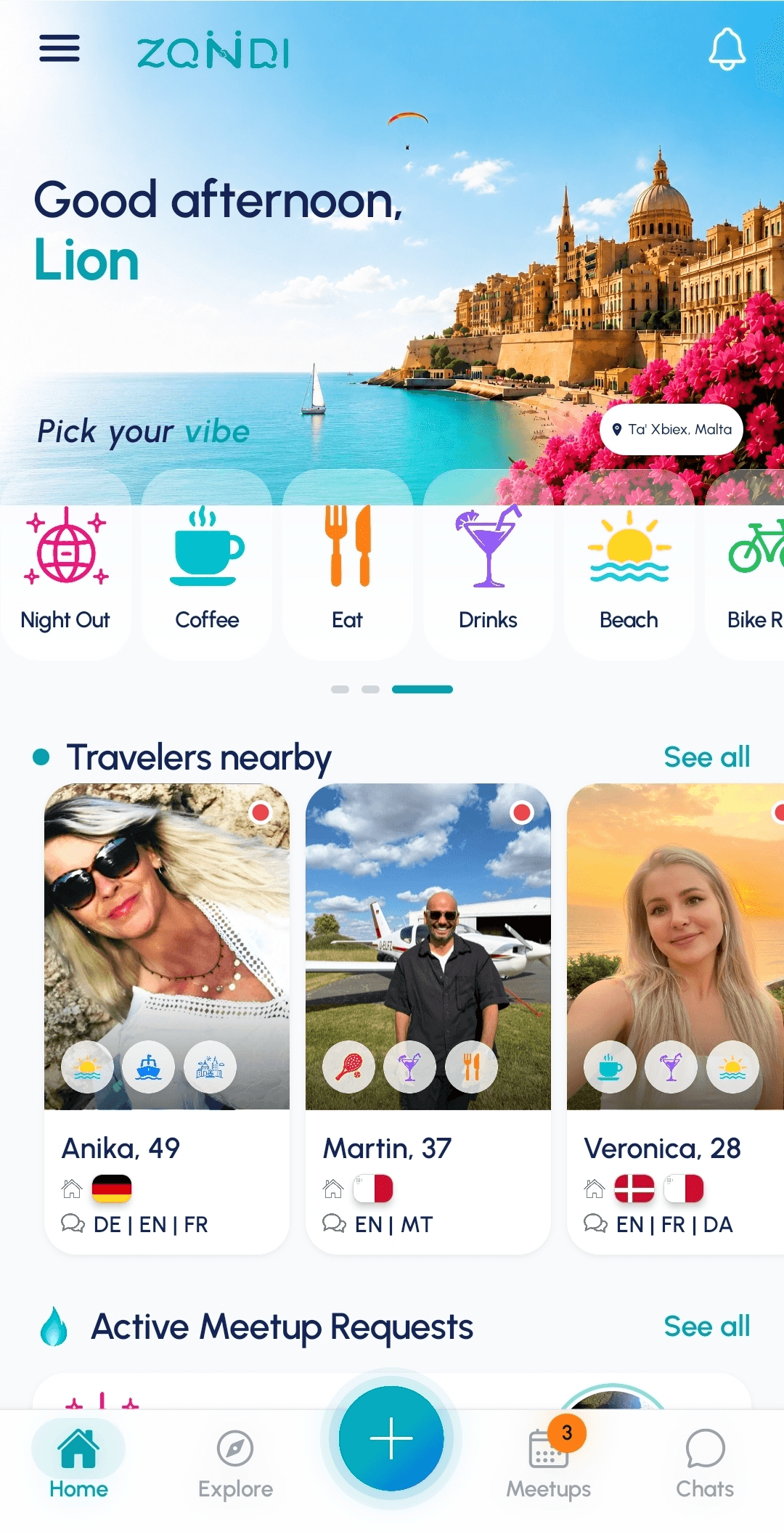
Why it works for travelers: the plan comes first, the people second. A solo traveler with a free afternoon can post “Coffee in Sliema at 4?” and hear from people who are nearby and interested. Profiles can be verified, and you can choose to see verified people only; both sides can rate each other after a meetup, so reputation builds over time. Your location is shown approximately, not as an exact live position, and Report and Block are built in. The app is multilingual, which matters in mixed expat cities. Core meetup functionality is free.
Where it falls short: ZONDI is new, and its coverage is geographically limited compared with the established global apps. It is live in Malta, with early access in Valencia, Barcelona and Limassol, and more destinations planned — if you are traveling elsewhere, it will not help you yet. The Android app is on Google Play and the web app works in any browser; the iOS app is still coming. The company is based in Malta, but the product is designed for multiple destinations, not for one island.
Verdict: ZONDI is designed to turn a free afternoon into a specific activity plan with people nearby. If you are in Malta or one of the early-access cities, it is worth opening first; if not, check back when your destination goes live.
6. Nomadtable — best for activities with other solo travelers
Nomadtable is the closest thing on this list to ZONDI in how it works: you browse activities near you that other travelers have created — dinner, sightseeing, a hike, a board-game night — join one, message the people in it, and meet. You can also add your next destination and get put into a group chat with travelers who will be there at the same time. The app is free, with a Nomadtable Plus subscription that unlocks things like the full list of nearby travelers and unlimited future-trip chats.
Why it works for travelers: it is built for the solo traveler’s exact situation — new city, no plans, wants company for something today — and it is available in many cities worldwide.
Where it falls short: it is traveler-to-traveler by design, so you are less likely to meet locals or long-term expats, and some of the “who is nearby” visibility sits behind the paid tier. Like any activity app, it is only as useful as the number of active people in your city that week.
Verdict: a strong pick for solo travelers in well-covered cities; in Malta and the early-access cities, compare it side by side with ZONDI and see where the activity you want is actually happening.
7. Hostelworld — best for traveler chats and events around hostels
Hostelworld’s app has grown from a booking tool into a social layer for travelers: city chats, chats based on shared interests, travel plans (see who is going where and when), traveler profiles and curated events such as pub crawls, hikes and beach parties. Booking a bed unlocks all of it. If you are not staying in a hostel, a Social Pass unlocks the same features without a booking — a one-time purchase from €4.99 for a week to €59.99 for a year, with no auto-renewal.
Why it works for travelers: the people in the chats are in your city now, often in your building, and the events are organised for exactly the “arrived alone, want company tonight” moment.
Where it falls short: it is a traveler-and-backpacker community, so you will rarely meet locals or expats, and the busiest chats are in destinations with a strong hostel scene. The Social Pass is another small cost if you are not booking anyway.
Verdict: essential if you stay in hostels; worth a Social Pass in hostel-heavy destinations even if you do not.
8. GAFFL — best for finding a travel buddy for a whole trip
GAFFL is for people who want a companion for an entire trip or a leg of it: you search a destination, browse trips, locals and nearby users, connect with someone, plan together and meet at a public place. Browsing and connecting are free.
Why it works for travelers: it solves a different problem — the multi-day “I don’t want to do this road trip alone” problem — better than any of the apps above.
Where it falls short: it is about planning ahead, not tonight. It is less useful once you are already in a city and want company for a few hours.
Verdict: a plan-before-you-go tool, not an on-the-ground one.
9. Facebook Groups — best for expat communities and local knowledge
Not an app for meeting people as such, but in many cities the most active social life for expats still runs through Facebook groups (“Expats in Malta”, “Valencia Expats”, “Digital Nomads Lisbon”) and the WhatsApp groups that spin off from them.
Why it works for travelers: free, everywhere, and full of people who have already answered “where do I meet people here?” a hundred times.
Where it falls short: it is a feed, not a matching tool. You post, hope someone answers, and coordinate in comments. Meetups are irregular and often organised by a small group of regulars.
Verdict: join the group for your destination before you land, then use an activity app for the actual plans.
Which app should you pick?
One free evening, big city: Couchsurfing Hangouts for travelers nearby right now; Timeleft if there is a dinner or drinks event you can book; Hostelworld events if you have a booking or a Social Pass.
Free afternoon in Malta, Valencia, Barcelona or Limassol: ZONDI — post the activity and see who nearby is interested; Nomadtable if it has active travelers in your city that week.
You want a coffee with someone, not a night out: an activity app where coffee is a category (ZONDI, Nomadtable), Timeleft’s daytime coffee format where it runs, or a daytime Meetup such as a language exchange. Coffee is the lowest-commitment first meetup and the easiest to get a yes to.
Hiking, beach day or a padel game: an activity-first app (ZONDI in Malta and the early-access cities, Nomadtable where travelers have posted one), a local hiking or padel Meetup group, or the destination’s Facebook group with a specific proposal (“Beach at Golden Bay, Saturday 11am, who’s in?”).
Staying a month or more: Meetup plus the local Facebook/WhatsApp community, and Bumble For Friends if you want one-to-one friendships.
Hostel traveler: Hostelworld chats first, then any of the above.
Multi-day trip and you don’t want to go alone: GAFFL.
You want to meet locals, not other tourists: Meetup groups run by locals, local sports communities, and activity apps that locals and expats use as well as travelers — ZONDI is built for that mix; Hostelworld, Nomadtable and Couchsurfing Hangouts are mostly traveler-to-traveler.
How to reduce no-shows
Every platform has flakes. Three things help, whichever app you use:
Propose something specific. “Coffee on the Sliema seafront, tomorrow at 10” gets confirmations; “we should hang out sometime” gets silence.
Keep it small and soon. Groups of two to four, within the next 48 hours. The further out the plan, the more likely life gets in the way.
Understand the commitment model. A booked event (Timeleft, Hostelworld events), a rating after the meetup (ZONDI) or a group chat with people who have already joined (Nomadtable, Bumble For Friends Plans) each raise the cost of not turning up in their own way. None of them make it zero.
Safety basics for meeting strangers abroad
Meet in public places, tell someone where you are going, keep your own transport, and use the app’s tools: verified profiles where offered, approximate rather than live location, report and block. Trust the feeling in the first ten minutes — you can always leave.
FAQs
What is the best app to meet people while traveling solo?
It depends on what you want to do. For scheduled events, Meetup. For spontaneous plans with other travelers, Couchsurfing Hangouts or Nomadtable. For a structured dinner, coffee or drinks with strangers, Timeleft. For doing a specific activity today with travelers, expats and locals nearby, ZONDI (currently Malta, Valencia, Barcelona and Limassol). Most solo travelers end up using two apps: one for events, one for spontaneous plans.
Are there free apps to meet people while traveling?
Yes. Meetup (joining most events), Bumble For Friends, ZONDI, Nomadtable, GAFFL and Facebook Groups are free for the basics. Timeleft is subscription-only, Couchsurfing requires a paid membership, and Hostelworld’s social features need a hostel booking or a Social Pass.
Which apps help you find people for hiking or beach activities?
Activity-first apps, because you search by the activity rather than by the person: ZONDI has hiking, beach and padel as categories in Malta and its early-access cities, and Nomadtable lets travelers post activities like hikes in many cities. Elsewhere, look for a hiking or outdoor Meetup group in your destination, or post a specific plan in the local Facebook group.
Which app is best for grabbing a coffee with someone when traveling alone?
Coffee is a low-commitment meetup that is easy to propose. On ZONDI you pick coffee as the activity and see who nearby is interested; Timeleft runs daytime “coffees with strangers” in some cities; on Couchsurfing Hangouts you can suggest it to travelers who are available now; Bumble For Friends works too, but expect more chatting before anyone commits.
How do I meet locals, not just other tourists?
Choose platforms locals actually use: hobby-based Meetup groups, local sports communities (padel, running, hiking), and activity apps built for locals and expats as well as travelers. Asking “anyone up for X on Saturday?” in a local group works better than asking for recommendations.
Is ZONDI a dating app?
No. ZONDI is built for activities and friendships: meetups are organised around a shared activity, groups are open, profiles can be verified, and people rate each other after the meetup. ZONDI at zondiapp.com and zondi.app is also not related to the Korean Jeju guesthouse app with the same name.
Which apps work in Malta?
Availability varies by service and city. ZONDI is live across Malta and is built for travelers, expats and locals together. For padel specifically, see our guide to finding a padel partner.
What about Tinder or Hinge for making friends?
People do it, but expect mixed intentions. Bumble For Friends or an activity app removes the ambiguity.
Sources and further reading
Meetup Help Center — event fees and member dues: help.meetup.com
Couchsurfing Support — how Couchsurfing works (Hangouts, membership): support.couchsurfing.org; membership plans: What Membership Plans Are Available?; verification: Why Did Verification Change?
Timeleft Help Center — event types: What types of events does Timeleft offer?; subscriptions: How do Timeleft Subscriptions Work?
Bumble For Friends — Plans: bumble.com/the-buzz/bumble-for-friends-plans; Premium: support.bumbleforfriends.com
Hostelworld — Social Pass: hostelworld.com/socialpass
Nomadtable — official site: nomadtable.app; app listing: Google Play
GAFFL — official site: gogaffl.com
ZONDI — zondiapp.com, web app at zondi.app, Android app on Google Play
Related ZONDI guides: How to Start Making Friends in Malta: The Solo Traveler’s Guide and How to Find a Padel Partner: 7 Easy Ways to Find Players Near You